
Your Tory Burch Capsule Wardrobe, Built Step by Step
A capsule built around a single label depends on that label having range, and this one has it, with ready-to-wear, denim, knitwear, outerwear, bags, shoes and swim under one roof. The risk is the opposite of scarcity. A broad assortment plus a recognisable logo makes six versions of the same idea an easy mistake. Rather than working inward from a wish list, this piece works outward from a budget. Every price quoted here is an observed market price, read on the brand’s own site in September 2026 rather than taken from an official price list, and figures move with season, market, material and channel. The target is eight to twelve pieces that combine without effort and last several years.
Fix the Budget Before You Choose Anything
Decide the total before the individual numbers, because individual numbers expand to fill whatever space you leave them. There are three usable bands in the observed 2026 prices. The entry band sits at roughly $95 to $200, taking in card cases, cosmetic cases, hair clips, jelly sandals, cotton tanks and the Miller sandal. Roughly $250 to $600 is the core band, covering most sandals, sneakers, loafers, ankle boots, mid-weight knitwear and most leather bags. The top band runs roughly $695 to $995 and covers tall boots, Lee Radziwill bags and tailored outerwear such as a double breasted wool coat at $995. Knowing which band a category sits in prevents the usual error of spending everything on one bag with nothing to wear it with.
The Bag That Carries the Capsule
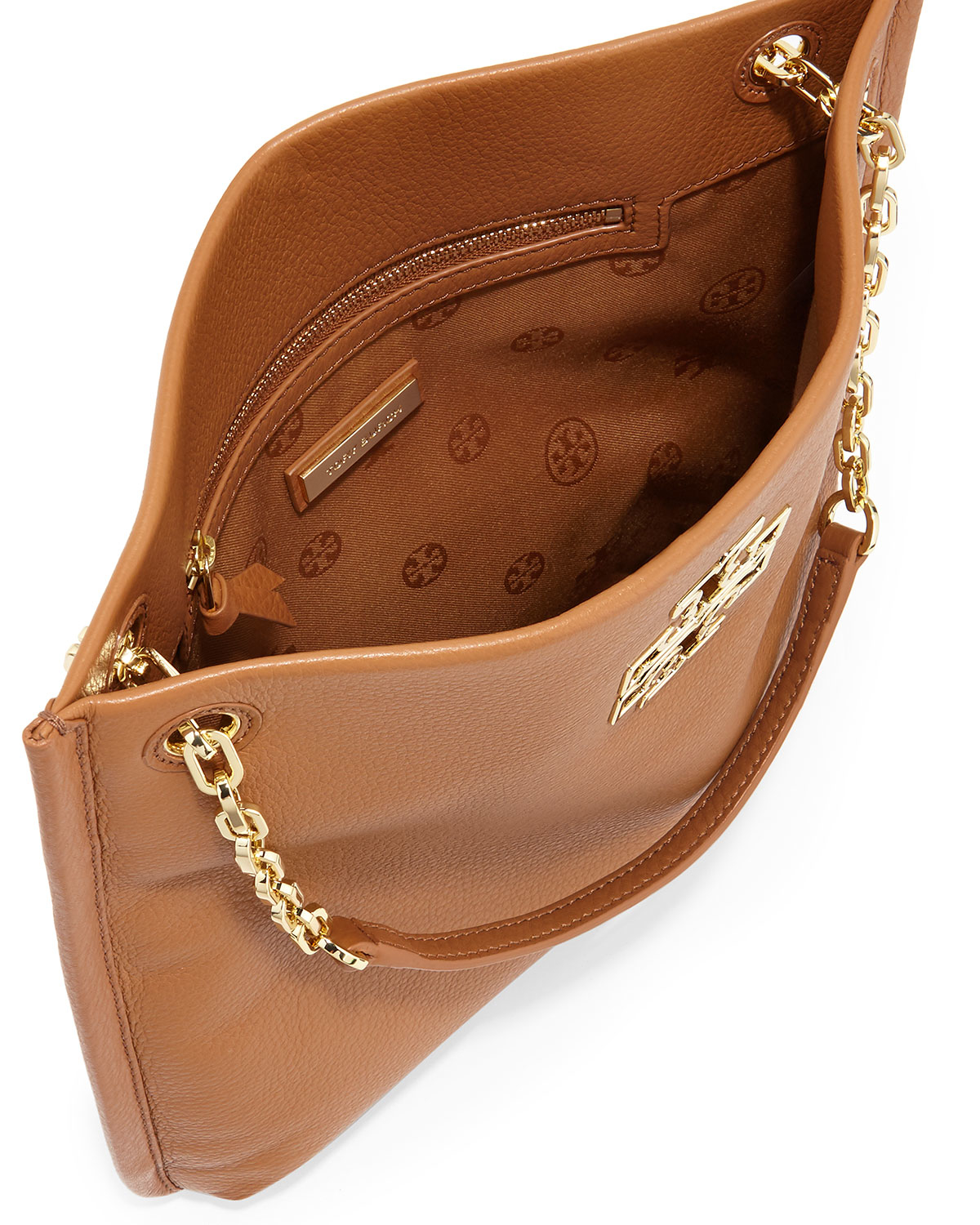
A single bag carries the capsule, so it earns the longest thought. The practical question is volume rather than style: a tote for a laptop, a structured satchel if it must hold shape empty, a crossbody if you carry little. At observed prices, an Ella twist Tory Burch reversible tote is $260, making nylon the cheapest route to a genuinely large bag. In leather the figures run $395 for a Perry tote or crossbody, $470 for a Fleming crossbody and $695 for a Fleming carryall, with the Lee Radziwill double bag at $595 petite and $795 small. Choose colour over model, because a mid-brown, black or deep neutral will beat a seasonal shade by years. Worth one note on naming, because Kira, Eleanor, Romy, Pierced and Miller are used for bags and for shoes alike, so filter by category.
Two Pairs of Shoes for Almost Every Day
Most of a normal week is covered by two pairs, one flat sandal or loafer and one closed shoe. Introduced in 2008, the Miller thong sandal is the recognisable entry point at an observed $200, while the cushioned Miller Cloud sandal is $225 and the lighter Miller Cloud Light $150. At $225, the Ines slide offers the same idea with a quieter logo. Closed shoes start with the classic loafer and LeeLee loafer, both observed at $325, plus field sneakers at $250. Paused in 2017 and relaunched in 2025 as a redesign, the Reva ballet flat is reported at roughly $330 to $350 against its original $195, which places it alongside loafers rather than below them. For autumn, the Romy Chelsea boot at $395 is the third pair rather than a second sandal.
Clothing: Knitwear, Denim and One Dress
Ready-to-wear is where a capsule earns its keep, and three categories do most of the work. Rather than a licence, denim is a genuine in-house category, with a slim leg jean observed at $350, a wide leg jean at $395, and one pair that fits properly supporting more outfits than anything else. The second pillar is knitwear, where a merino wool turtleneck is $420 and a T Monogram jacquard cardigan $550. A single dress covers what the first two cannot, and at $550 a printed viscose jersey dress travels further than a more decorative option. Below those, cotton scoop tanks and ribbed tank tops at $150 make tory burch clothing you already own more wearable. The house style is elevated American sportswear with an off-kilter femininity, so plain pieces carry the printed ones.
The Expensive Decision: Outerwear
In every capsule there is one item that costs more than it looks worth, and here it tends to be the coat. Topping the range is a double breasted wool coat at an observed $995, with a corduroy blazer at $750 beneath it. The case for spending here is arithmetic and not aspiration, because a coat goes over almost everything else and wears out slowly. The argument against is that it competes with specialist outerwear makers and should be judged on cut and cloth rather than label. If the budget cannot carry both a coat and an anchor bag, buy the bag first, because a bag works year-round. The compromise is a blazer, which works as outerwear indoors and as a layer outdoors.
Three Routes, Priced
Built from observed September 2026 prices, the routes below are shapes rather than shopping lists. Internal consistency is the rule, and within a row every piece works with every other piece. A little over a thousand dollars buys the starter route, a wearable capsule built on nylon and the entry shoe band. The considered route costs about twice as much, trading nylon for leather and adding a second bag plus better knitwear. The full route takes the top band twice over, once for the coat and once for the bag. No total here includes tax, alterations or shoe protection, and every one assumes full price, which the next section argues against.
| Route | The pieces | Total at observed 2026 prices |
|---|---|---|
| Starter | Ella twist reversible tote $260, Miller sandal $200, field sneaker $250, cotton scoop tank $150, slim leg jean $350 | $1,210 all in |
| Considered route | Fleming crossbody $470, Perry tote $395, classic loafer $325, Miller Cloud sandal $225, wide leg jean $395, merino turtleneck $420 | $2,230 |
| The full shape | Small Lee Radziwill double bag $795, Romy ankle boot $495, classic loafer $325, wool V-neck sweater $495, T Monogram straight leg jean $395, double breasted wool coat $995 | $3,500 all in |
Buying at the Right Moment: Where the Discount Actually Sits
Building this at full price in one month is unnecessary. The brand runs a recurring semi-annual sale, and coverage of the July 2026 edition described sandals under $100 and reductions of up to about half, while deeper claims of up to seventy percent belong to promotional copy rather than any guarantee. There is also a separate private sale gated to account holders, reported to run roughly twice a year, although that cadence is unconfirmed. A tory burch outlet network does exist physically, inside premium outlet centres, while the company states plainly that no online outlet is operated, which means any site advertising itself as one is not the brand. In 2026 the off-price picture changed, since Nordstrom Rack and TJ Maxx continue to carry the label and remain legitimate, whereas Saks OFF 5TH closed its e-commerce operation altogether after Saks Global’s bankruptcy earlier in the year. Buy the pieces that rarely discount at full price and wait for the rest, in this order.
- The anchor bag first, in a neutral colour, whatever the price.
- A single pair of closed shoes, tried on in person for fit.
- Denim, because fit decides everything and returns are tedious.
- Knitwear in a genuine tory burch sale, when seasonal markdowns run deepest.
- Sandals once late summer arrives and the semi-annual event lands.
- Coat at the end, and only once the rest already works.
Fit and Sizing, Plus Returns
The largest single cause of a wasted purchase here is fit, and buyer reports are consistent enough to plan around. Long-running buyer threads describe tory burch shoes as running narrow across the line, and this is buyer consensus rather than brand policy. The Miller sandal draws the most comments about running slightly small and narrow, half a size up is the usual advice, and a wide width is available for it. The Reva collects mixed reports, with some finding it true to size, many going up half a size, and the common view calling it shallow and narrow through the toe box. A wide version exists for some styles, including the Ines slide, so check before assuming a style is closed to you. Buy knitwear and denim in person where possible, since sale garments are often final sale.
What Not to Buy
What you refuse defines a capsule as much as what you buy. Skip the second logo-heavy bag, since two recognisable pieces in a single outfit read as a uniform rather than a wardrobe. Unless you genuinely travel for them, leave seasonal swim and beach pieces alone, as a $470 long linen caftan is a holiday purchase rather than a foundation. Leave fragrance, watches and eyewear out of the capsule maths entirely: fragrance runs under a Shiseido licence effective from the start of 2020 and eyewear under a long-standing Luxottica licence. The runway is not a higher tier, whatever the assumption, because runway pieces feed the same seasonal main collection instead of a separate diffusion line. Fewer, plainer things from tory burch, worn harder, beat buying more.